new

Get trending papers in your email inbox!

Subscribe

Trending Papers

byAK and the research community

Trending Papers
Submitted by
amael-apple

Sharp Monocular View Synthesis in Less Than a Second

SHARP synthesizes photorealistic views from a single image using a 3D Gaussian representation, achieving state-of-the-art results with rapid processing.

apple Apple · Dec 11, 2025
Submitted by
jt-zhang

TurboDiffusion: Accelerating Video Diffusion Models by 100-200 Times

TurboDiffusion accelerates video generation by 100-200x using attention acceleration, step distillation, and quantization, while maintaining video quality.

Submitted by
andito

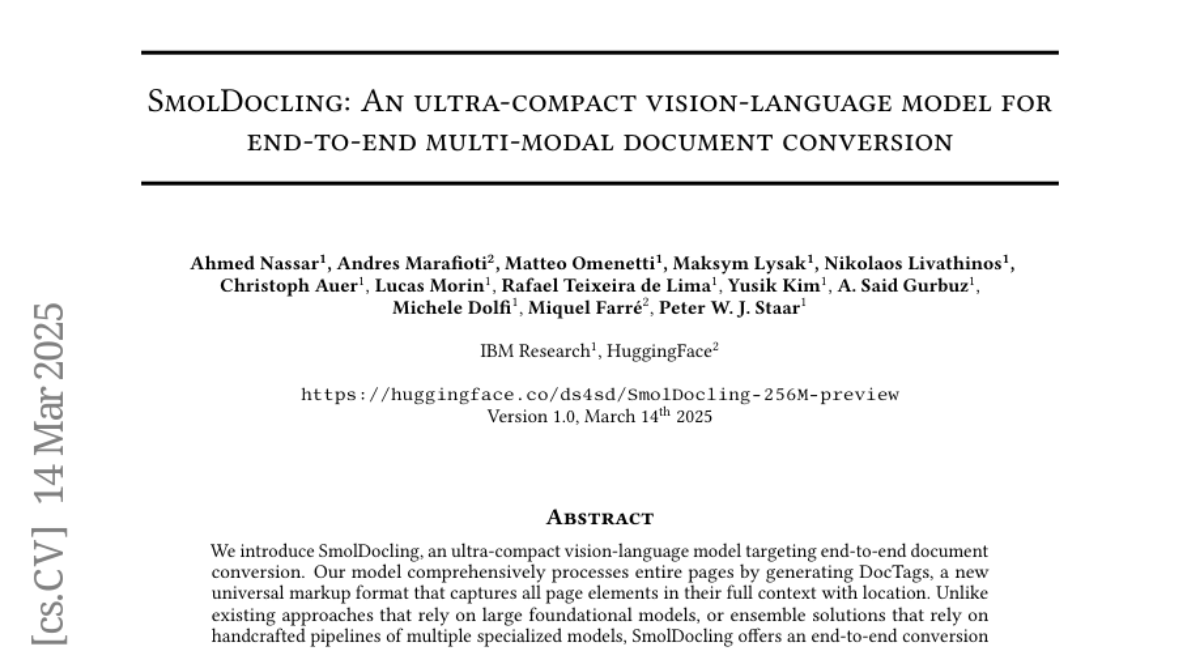
SmolDocling: An ultra-compact vision-language model for end-to-end multi-modal document conversion

SmolDocling is a compact vision-language model that performs end-to-end document conversion with robust performance across various document types using 256M parameters and a new markup format.

ibm-granite IBM Granite · Mar 14, 2025

Self-Supervised Prompt Optimization

A self-supervised framework optimizes prompts for both closed and open-ended tasks by evaluating LLM outputs without external references, reducing costs and required data.

  • 9 authors
· Feb 7, 2025
Submitted by
hao-li

Agent READMEs: An Empirical Study of Context Files for Agentic Coding

Agentic coding tools receive goals written in natural language as input, break them down into specific tasks, and write or execute the actual code with minimal human intervention. Central to this process are agent context files ("READMEs for agents") that provide persistent, project-level instructions. In this paper, we conduct the first large-scale empirical study of 2,303 agent context files from 1,925 repositories to characterize their structure, maintenance, and content. We find that these files are not static documentation but complex, difficult-to-read artifacts that evolve like configuration code, maintained through frequent, small additions. Our content analysis of 16 instruction types shows that developers prioritize functional context, such as build and run commands (62.3%), implementation details (69.9%), and architecture (67.7%). We also identify a significant gap: non-functional requirements like security (14.5%) and performance (14.5%) are rarely specified. These findings indicate that while developers use context files to make agents functional, they provide few guardrails to ensure that agent-written code is secure or performant, highlighting the need for improved tooling and practices.

  • 11 authors
· Nov 17, 2025
Submitted by
akhaliq

Efficient Memory Management for Large Language Model Serving with PagedAttention

PagedAttention algorithm and vLLM system enhance the throughput of large language models by efficiently managing memory and reducing waste in the key-value cache.

  • 9 authors
· Sep 12, 2023
Submitted by
ethanchern

LiveTalk: Real-Time Multimodal Interactive Video Diffusion via Improved On-Policy Distillation

Real-time multimodal video generation via diffusion is enabled by an improved distillation approach with multimodal conditioning and optimized scheduling, reducing inference latency while maintaining quality for interactive systems.

  • 7 authors
· Dec 29, 2025
Submitted by
Yuanshi

SpotEdit: Selective Region Editing in Diffusion Transformers

Diffusion Transformer models have significantly advanced image editing by encoding conditional images and integrating them into transformer layers. However, most edits involve modifying only small regions, while current methods uniformly process and denoise all tokens at every timestep, causing redundant computation and potentially degrading unchanged areas. This raises a fundamental question: Is it truly necessary to regenerate every region during editing? To address this, we propose SpotEdit, a training-free diffusion editing framework that selectively updates only the modified regions. SpotEdit comprises two key components: SpotSelector identifies stable regions via perceptual similarity and skips their computation by reusing conditional image features; SpotFusion adaptively blends these features with edited tokens through a dynamic fusion mechanism, preserving contextual coherence and editing quality. By reducing unnecessary computation and maintaining high fidelity in unmodified areas, SpotEdit achieves efficient and precise image editing.

Submitted by
Paper99

Z-Image: An Efficient Image Generation Foundation Model with Single-Stream Diffusion Transformer

Z-Image, a 6B-parameter Scalable Single-Stream Diffusion Transformer (S3-DiT) model, achieves high-performance image generation with reduced computational cost, offering sub-second inference and compatibility with consumer hardware.

Tongyi-MAI Tongyi-MAI · Nov 27, 2025
Submitted by
Cxxs

Decoupled DMD: CFG Augmentation as the Spear, Distribution Matching as the Shield

The study reveals that in text-to-image generation, CFG Augmentation is the primary driver of few-step distillation in Distribution Matching Distillation (DMD), while the distribution matching term acts as a regularizer.

Tongyi-MAI Tongyi-MAI · Nov 27, 2025
Submitted by
Rbin

RAG-Anything: All-in-One RAG Framework

RAG-Anything is a unified framework that enhances multimodal knowledge retrieval by integrating cross-modal relationships and semantic matching, outperforming existing methods on complex benchmarks.

Submitted by
kpzhang996

Yume-1.5: A Text-Controlled Interactive World Generation Model

Recent approaches have demonstrated the promise of using diffusion models to generate interactive and explorable worlds. However, most of these methods face critical challenges such as excessively large parameter sizes, reliance on lengthy inference steps, and rapidly growing historical context, which severely limit real-time performance and lack text-controlled generation capabilities. To address these challenges, we propose \method, a novel framework designed to generate realistic, interactive, and continuous worlds from a single image or text prompt. \method achieves this through a carefully designed framework that supports keyboard-based exploration of the generated worlds. The framework comprises three core components: (1) a long-video generation framework integrating unified context compression with linear attention; (2) a real-time streaming acceleration strategy powered by bidirectional attention distillation and an enhanced text embedding scheme; (3) a text-controlled method for generating world events. We have provided the codebase in the supplementary material.

  • 9 authors
· Dec 26, 2025
Submitted by
taesiri

PaddleOCR-VL: Boosting Multilingual Document Parsing via a 0.9B Ultra-Compact Vision-Language Model

PaddleOCR-VL, a vision-language model combining NaViT-style dynamic resolution and ERNIE, achieves state-of-the-art performance in document parsing and element recognition with high efficiency.

PaddlePaddle PaddlePaddle · Oct 16, 2025
Submitted by
akhaliq

FunAudioLLM: Voice Understanding and Generation Foundation Models for Natural Interaction Between Humans and LLMs

FunAudioLLM enhances voice interactions by integrating SenseVoice for multilingual speech recognition, emotion detection, and audio event detection with CosyVoice for natural speech generation across languages, timbres, and styles.

  • 1 authors
· Jul 4, 2024
Submitted by
akhaliq

Very Large-Scale Multi-Agent Simulation in AgentScope

Enhancements to the AgentScope platform improve scalability, efficiency, and ease of use for large-scale multi-agent simulations through distributed mechanisms, flexible environments, and user-friendly tools.

  • 8 authors
· Jul 25, 2024
Submitted by
wanderkid

MinerU: An Open-Source Solution for Precise Document Content Extraction

MinerU is an open-source tool that enhances document content extraction using fine-tuned models and pre/postprocessing rules across diverse document types.

  • 18 authors
· Sep 27, 2024
Submitted by
taesiri

MinerU2.5: A Decoupled Vision-Language Model for Efficient High-Resolution Document Parsing

MinerU2.5, a 1.2B-parameter document parsing vision-language model, achieves state-of-the-art recognition accuracy with computational efficiency through a coarse-to-fine parsing strategy.

  • 61 authors
· Sep 26, 2025
Submitted by
taesiri

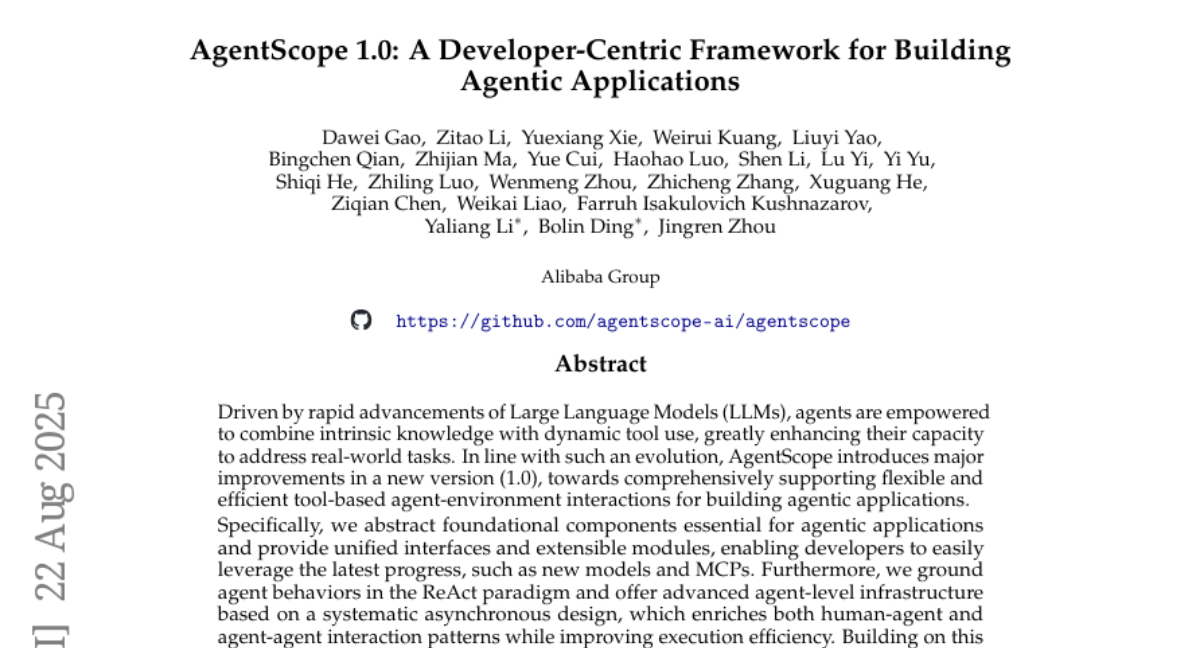
AgentScope 1.0: A Developer-Centric Framework for Building Agentic Applications

AgentScope enhances agentic applications by providing flexible tool-based interactions, unified interfaces, and advanced infrastructure based on the ReAct paradigm, supporting efficient and safe development and deployment.

  • 23 authors
· Aug 22, 2025
Submitted by
taesiri

StoryMem: Multi-shot Long Video Storytelling with Memory

StoryMem enhances multi-shot video generation with cinematic quality and long-range consistency using a memory bank and pre-trained single-shot video diffusion models.

ByteDance ByteDance · Dec 22, 2025

TradingAgents: Multi-Agents LLM Financial Trading Framework

A multi-agent framework using large language models for stock trading simulates real-world trading firms, improving performance metrics like cumulative returns and Sharpe ratio.

  • 4 authors
· Dec 28, 2024
Submitted by
unilm

VibeVoice Technical Report

VibeVoice synthesizes long-form multi-speaker speech using next-token diffusion and a highly efficient continuous speech tokenizer, achieving superior performance and fidelity.

MicrosoftResearch Microsoft Research · Aug 26, 2025

IndexTTS: An Industrial-Level Controllable and Efficient Zero-Shot Text-To-Speech System

IndexTTS, an enhanced text-to-speech system combining XTTS and Tortoise models, offers improved naturalness, enhanced voice cloning, and controllable usage through hybrid character-pinyin modeling and optimized vector quantization.

  • 5 authors
· Feb 8, 2025

LightRAG: Simple and Fast Retrieval-Augmented Generation

LightRAG improves Retrieval-Augmented Generation by integrating graph structures for enhanced contextual awareness and efficient information retrieval, achieving better accuracy and response times.

  • 5 authors
· Oct 8, 2024
Submitted by
taesiri

Step-DeepResearch Technical Report

Step-DeepResearch, an end-to-end agent enhanced with a data synthesis strategy and progressive training, achieves expert-level capabilities in deep research scenarios, outperforming established models.

stepfun-ai StepFun · Dec 23, 2025
Submitted by
taesiri

PersonaLive! Expressive Portrait Image Animation for Live Streaming

PersonaLive is a diffusion-based framework for real-time portrait animation that enhances speed and efficiency through multi-stage training, hybrid implicit signals, appearance distillation, and autoregressive micro-chunk streaming.

Submitted by
akhaliq

LlamaFactory: Unified Efficient Fine-Tuning of 100+ Language Models

LlamaFactory is a unified framework enabling efficient fine-tuning of large language models across various tasks using a web-based user interface.

  • 5 authors
· Mar 20, 2024
Submitted by
Jiaqi-hkust

Robust-R1: Degradation-Aware Reasoning for Robust Visual Understanding

A novel framework, Robust-R1, enhances multimodal large language models' robustness to visual degradations through explicit modeling, supervised fine-tuning, reward-driven alignment, and dynamic reasoning depth scaling, achieving state-of-the-art performance on real-world degradation benchmarks.

  • 10 authors
· Dec 19, 2025
Submitted by
zbhpku

DataFlow: An LLM-Driven Framework for Unified Data Preparation and Workflow Automation in the Era of Data-Centric AI

DataFlow is an LLM-driven data preparation framework that enhances data quality and reproducibility for various tasks, improving LLM performance with automatically generated pipelines.

PekingUniversity Peking University · Dec 18, 2025

AI-Trader: Benchmarking Autonomous Agents in Real-Time Financial Markets

AI-Trader evaluates the performance of large language models in real-world financial markets, highlighting their limitations in trading and risk management.

  • 6 authors
· Dec 1, 2025
Submitted by
taesiri

SAM 3: Segment Anything with Concepts

Segment Anything Model 3 achieves state-of-the-art performance in promptable concept segmentation and tracking by leveraging a unified model architecture with decoupled recognition and localization.

facebook AI at Meta · Nov 20, 2025

olmOCR: Unlocking Trillions of Tokens in PDFs with Vision Language Models

olmOCR is an open-source toolkit using a fine-tuned vision language model to process PDFs into clean text while preserving structure, optimized for large-scale batch processing.

  • 9 authors
· Feb 25, 2025
Submitted by
Jeff-Wang

GigaBrain-0: A World Model-Powered Vision-Language-Action Model

GigaBrain-0, a VLA foundation model, uses world model-generated data to enhance cross-task generalization and policy robustness, improving real-world performance on complex manipulation tasks.

open-gigaai GigaAI · Oct 22, 2025

Zep: A Temporal Knowledge Graph Architecture for Agent Memory

Zep, a memory layer service, outperforms MemGPT in the DMR benchmark and LongMemEval by excelling in dynamic knowledge integration and temporal reasoning, critical for enterprise use cases.

  • 5 authors
· Jan 20, 2025
Submitted by
taesiri

HunyuanVideo 1.5 Technical Report

HunyuanVideo 1.5 is a lightweight video generation model with state-of-the-art visual quality and motion coherence, using a DiT architecture with SSTA and an efficient video super-resolution network.

  • 81 authors
· Nov 24, 2025
Submitted by
Sansa

Dream-VL & Dream-VLA: Open Vision-Language and Vision-Language-Action Models with Diffusion Language Model Backbone

Diffusion-based vision-language models and action frameworks demonstrate superior performance in visual planning and robotic control tasks compared to autoregressive baselines.

Submitted by
akhaliq

Mem0: Building Production-Ready AI Agents with Scalable Long-Term Memory

Mem0, a memory-centric architecture with graph-based memory, enhances long-term conversational coherence in LLMs by efficiently extracting, consolidating, and retrieving information, outperforming existing memory systems in terms of accuracy and computational efficiency.

  • 5 authors
· Apr 28, 2025
Submitted by
Weiyun1025

InternVL3: Exploring Advanced Training and Test-Time Recipes for Open-Source Multimodal Models

InternVL3 is a multimodal pre-trained language model that jointly learns from both multimodal data and text, improving performance and scalability through advanced techniques and setting a new state-of-the-art in multimodal tasks.

  • 47 authors
· Apr 14, 2025
Submitted by
taesiri

SAM Audio: Segment Anything in Audio

SAM Audio, a diffusion transformer-based foundation model, achieves superior performance in general audio separation using unified text, visual, and temporal span prompts across various audio types.

facebook AI at Meta · Dec 19, 2025

OmniFlatten: An End-to-end GPT Model for Seamless Voice Conversation

A novel GPT-based model, OmniFlatten, enables real-time natural full-duplex spoken dialogue through a multi-stage post-training technique that integrates speech and text without altering the original model's architecture.

  • 9 authors
· Oct 23, 2024
Submitted by
daixufang

Agent Lightning: Train ANY AI Agents with Reinforcement Learning

Agent Lightning is a flexible RL framework for training LLMs in various agents, using a hierarchical RL algorithm and decoupling execution from training to handle complex interactions.

  • 8 authors
· Aug 5, 2025
Submitted by
wymanCV

Stable Video Infinity: Infinite-Length Video Generation with Error Recycling

Stable Video Infinity generates infinite-length videos with high temporal consistency and controllable storylines by using Error-Recycling Fine-Tuning on the Diffusion Transformer.

epfl-vita EPFL VITA Lab · Oct 10, 2025
Submitted by
dyyyyyyyy

FAPO: Flawed-Aware Policy Optimization for Efficient and Reliable Reasoning

Flawed-Aware Policy Optimization (FAPO) enhances reinforcement learning with verifiable rewards by penalizing flawed-positive rollouts, improving reasoning capability and training stability in large language models.

  • 6 authors
· Oct 26, 2025
Submitted by
Andrew613

UniPercept: Towards Unified Perceptual-Level Image Understanding across Aesthetics, Quality, Structure, and Texture

Multimodal large language models (MLLMs) have achieved remarkable progress in visual understanding tasks such as visual grounding, segmentation, and captioning. However, their ability to perceive perceptual-level image features remains limited. In this work, we present UniPercept-Bench, a unified framework for perceptual-level image understanding across three key domains: Aesthetics, Quality, Structure and Texture. We establish a hierarchical definition system and construct large-scale datasets to evaluate perceptual-level image understanding. Based on this foundation, we develop a strong baseline UniPercept trained via Domain-Adaptive Pre-Training and Task-Aligned RL, enabling robust generalization across both Visual Rating (VR) and Visual Question Answering (VQA) tasks. UniPercept outperforms existing MLLMs on perceptual-level image understanding and can serve as a plug-and-play reward model for text-to-image generation. This work defines Perceptual-Level Image Understanding in the era of MLLMs and, through the introduction of a comprehensive benchmark together with a strong baseline, provides a solid foundation for advancing perceptual-level multimodal image understanding.

  • 15 authors
· Dec 25, 2025
Submitted by
X-iZhang

A Comprehensive Survey of Self-Evolving AI Agents: A New Paradigm Bridging Foundation Models and Lifelong Agentic Systems

A survey of self-evolving AI agents that adapt to dynamic environments through automatic enhancement based on interaction data and feedback.

  • 15 authors
· Aug 10, 2025
Submitted by
myyzzzoooo

InsertAnywhere: Bridging 4D Scene Geometry and Diffusion Models for Realistic Video Object Insertion

InsertAnywhere framework enhances video object insertion by generating geometrically consistent and visually coherent scenarios through 4D aware mask generation and diffusion-based synthesis.

kaist-ai KAIST AI · Dec 19, 2025

LeVo: High-Quality Song Generation with Multi-Preference Alignment

LeVo, a framework combining an LM and a music codec, improves lyrics-to-song generation by parallelly modeling mixed and dual-track tokens, using transformer decoders, and employing direct preference optimization to enhance musicality and instruction following.

  • 13 authors
· Jun 9, 2025
Submitted by
zhongwenxu

Single-stream Policy Optimization

Single-stream Policy Optimization (SPO) improves policy-gradient training for Large Language Models by eliminating group-based issues and providing a stable, low-variance learning signal, leading to better performance and efficiency.

tencent Tencent · Sep 16, 2025
Submitted by
taesiri

DeepCode: Open Agentic Coding

DeepCode, a fully autonomous framework, addresses the challenges of document-to-codebase synthesis by optimizing information flow through source compression, structured indexing, knowledge injection, and error correction, achieving state-of-the-art performance and surpassing human experts.

  • 5 authors
· Dec 8, 2025

PyTorch FSDP: Experiences on Scaling Fully Sharded Data Parallel

PyTorch Fully Sharded Data Parallel (FSDP) enables efficient and scalable training of large models across hardware configurations.

  • 16 authors
· Apr 21, 2023

VideoRAG: Retrieval-Augmented Generation with Extreme Long-Context Videos

VideoRAG enhances large language models for multi-modal video processing with a dual-channel architecture that integrates textual knowledge grounding and multi-modal context encoding.

  • 6 authors
· Feb 3, 2025